
An independent Penang guide — est. 2017
In-House Compounding and Filling: Before Your First Factory Call
The first call with a factory that compounds and fills in house is not a pitch; it is a capability check in both directions. The supplier is assessing whether your project can be produced, and you are assessing whether the process behind the product is understood. Brands that arrive with five documents get a far more useful conversation than brands that arrive with an idea, because compounding and filling are the stages where vague inputs become expensive changes.
Key takeaways
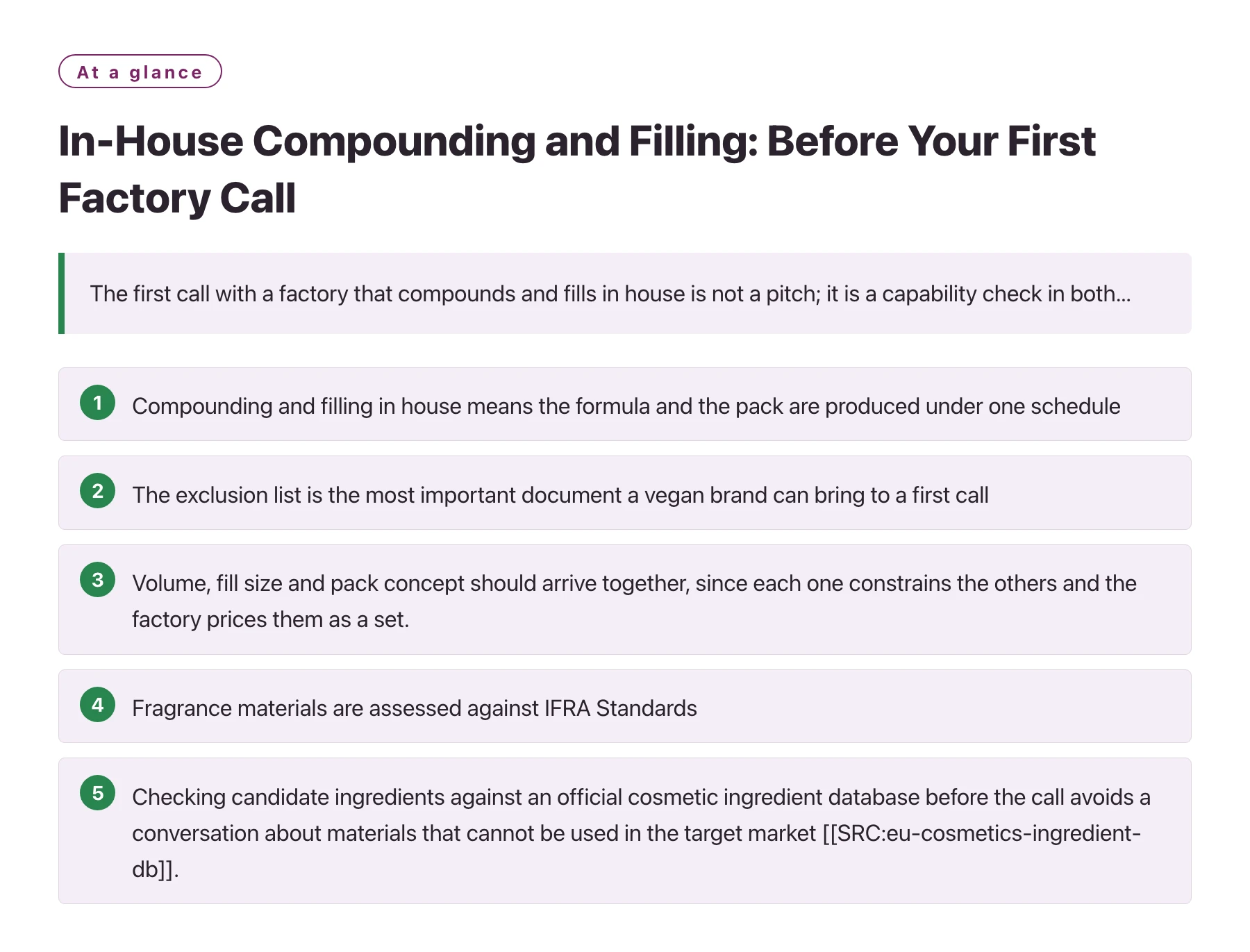
- Compounding and filling in house means the formula and the pack are produced under one schedule, which reduces handover risk but does not remove the need for a clear brief.
- The exclusion list is the most important document a vegan brand can bring to a first call, because it determines which materials can be dispensed at all.
- Volume, fill size and pack concept should arrive together, since each one constrains the others and the factory prices them as a set.
- Fragrance materials are assessed against IFRA Standards, and confirming that assessment is part of the factory's normal intake work rather than a special request [1].
- Checking candidate ingredients against an official cosmetic ingredient database before the call avoids a conversation about materials that cannot be used in the target market [2].
- Ownership of the formula and any custom tooling is a commercial question with a documented answer, and general guidance on protecting such assets is published by the World Intellectual Property Organization [3].
Most supplier calls go badly for a simple reason: the brand describes a product while the factory needs to schedule a process. Compounding has batch sizes, dispensing tolerances and maceration time; filling has line formats, fill accuracy and changeover cost. None of those can be estimated from a mood board.
This is a preparation guide for a product developer or founder preparing a first call. It lists the material to bring, the gaps that cause most delay, and the questions worth asking about in-house capability.
What in-house compounding and filling actually means
When a factory compounds in house, it weighs and blends the fragrance concentrate on site, then macerates, filters and fills. When it fills in house as well, the same site controls the transition from bulk liquid to finished unit. That is a meaningful scope, because it places the two stages where most quality variation is introduced under one management system.
It does not mean everything is made on site. Bottles, caps, pumps and printed cartons are often sourced from specialist suppliers, and decoration may be handled by a third party. Part of a first call is mapping which parts of the pack the factory controls and which it coordinates.
The practical benefit of a single site is a shorter information path. A change to the fill size or to a component reaches the filling plan directly instead of being relayed between companies. The corresponding risk is dependency: if the site is busy, there is no alternative line to absorb your order.
That is why the call should cover capacity and scheduling as openly as it covers capability. A factory describing fragrance OEM and ODM manufacturing services is offering a scope, and the useful follow-up question is where your project sits inside it.
Five documents to bring to the first call
| Document | Why the factory needs it | The gap that causes delay |
|---|---|---|
| Product brief | It fixes the format, the concentration and the intended use, which determine the process route | A scent description with no format, so the factory has to guess the product it is costing |
| Volume and fill size | Both drive batch size, line changeover and component purchasing | A volume range so wide that the quote covers nothing specific |
| Exclusion list | It determines which materials can be dispensed and which substitutes are permitted | A vegan claim with no written list of excluded materials or classes |
| Pack concept | Component type, closure and decoration define the filling and packing steps | A pack concept that arrives only after the scent has been approved |
| Market list | Each destination market has its own documentation and labelling work | A market list revealed at shipping, after artwork has been approved |
The third column is the part to read twice. In most projects the delay is not caused by a difficult product but by one of these five inputs arriving late.
The questions that reveal how compounding is controlled
Capability questions are best asked as process questions. Instead of asking whether the factory can handle a vegan specification, ask how materials are stored and dispensed when two specifications run through the same area. The answer describes segregation, cleaning and record keeping in one go.
Ask how the batch size of the concentrate relates to the batch size of the finished goods, and whether a minimum compounding quantity applies. This is where a small first order can become unexpectedly expensive, because a minimum concentrate batch may exceed what the first order needs.
Ask about maceration. The period between compounding and filling affects how the scent settles, and it is a legitimate reason for part of the lead time. A factory that can describe its own maceration practice is showing that the stage is scheduled rather than improvised.
Ask how changes to a formula are recorded after approval. This matters more on a vegan line, because a substitution affects both the scent and the material evidence. The best answer names a written change control and a re-approval step rather than a verbal understanding.
Finally, ask which of these steps happen under one roof. That is the question that determines whether your project is genuinely R&D and manufacturing in one place or coordinated across several suppliers with the factory in the middle.
What to ask about filling and packing
Filling questions are more mechanical and easier to verify. Ask which container formats the line handles, what fill accuracy is normal, and how the line is cleaned between products. Fill accuracy matters commercially because an overfill across a large order is a real cost, and underfill creates a compliance problem.
Changeover is the hidden cost in small orders. Every new component, cap type or decoration step requires a setup, and those setups are charged somewhere. Asking how changeover is managed makes it possible to decide whether to launch several formats together or to sequence them.
Packing capability deserves its own question, because it determines how much of the presentation the factory can take responsibility for. Some sites can assemble, insert and shrink-wrap; others hand the finished units to a third party. Neither is wrong, but the brand needs to know which is happening.
Where the brand plans a distinctive pack, it is worth discussing decoration early enough for the choice to be costed with the scent rather than after it. A pack that requires a technique the site cannot handle will add a supplier to the chain and a handover to the schedule.
Preparing the brand side, not just the documents
Two internal preparations make the technical conversation much shorter. The first is a single decision maker for scent approval, because a factory planning several evaluation rounds needs to know who signs. The second is a defined price band, because the factory can trade off dosage, fill size and pack only if it knows the constraint.
It also helps to be clear about what the brand intends to own. Formula ownership, exclusivity and tooling are separate questions, and they are easier to discuss before sampling than after a scent has been chosen. General guidance from the World Intellectual Property Organization on protecting formulations and designs is a reasonable background for that discussion [3].
If the team includes people who have never briefed a perfumer, a short course or workshop can pay for itself in fewer wasted rounds. The existence of professional scent training is worth noting for brands that want to build internal evaluation skills rather than relying entirely on the supplier.
And it is worth asking whether the factory expects to be given a direction or a formula. A supplier describing itself as a factory that turns a brief into a scent is offering development work, while a supplier that mainly compounds is expecting a direction it can produce. Confusing the two is the most common reason a first call ends without a next step.
Send the five documents before the call, not during it. A factory that has read your brief in advance will spend the meeting on process questions, and the answers to those questions are what tell you whether the capability fits your project.
Sources
- IFRA Standards Library (International Fragrance Association) —— The IFRA Standards Library lists the restrictions the fragrance industry applies to individual fragrance ingredients, based on safety assessments; it is the reference point for compliant fragrance formulation.
- EU CosIng — Cosmetic Ingredient Database (European Commission) —— The European Commission's CosIng database of cosmetic ingredients, listing ingredient functions, restrictions and labelling requirements under EU cosmetics law.
- WIPO — World Intellectual Property Organization —— The UN agency for intellectual property; resources on industrial design and patent protection relevant to product and packaging design.
Frequently asked questions
What does in-house compounding mean in practice?
It means the fragrance concentrate is weighed and blended on the factory site, rather than arriving as a finished solution from another company. The site then controls maceration and filtration before filling, which keeps the most variation-prone stages in one schedule.
Do I need a formula before approaching a factory?
No, if the factory offers development. You need a clear brief, a format and an exclusion list. A factory that only compounds will expect a direction from a perfumer, so it is worth establishing which kind of partner you are speaking to before the call.
How does a vegan specification change the first call?
It adds material segregation and substitution control to the agenda. Bring a written exclusion list and ask how dispensing is separated when several specifications run in the same area. Those two points reveal more than a general question about whether vegan work is possible.
What minimum order quantities should I expect?
They depend on the concentrate batch size, the filling line format and the components. A useful question is which of the three sets the floor, because that is the constraint to relax if the first order is small.
Should the pack be discussed in the first call?
Yes. Component type, closure and decoration affect filling and packing, and changeover cost is charged somewhere. Bringing the pack concept early lets the factory cost the whole product instead of the liquid alone.
How should ownership of the formula be raised?
Directly, and before sampling. Ask whether the formula is treated as project-specific, whether exclusivity applies, and what happens to the work if the relationship ends. Getting that in writing early avoids a much harder conversation later.